The fastest way to vet a cleaning products manufacturer is to ask five things and check the answers: business licence and export history, which production lines they own rather than rent, current certificates with a scope that covers your product, a sample pulled from a running batch, and the inspection standard they accept before shipping. A real factory answers all five the same day with documents attached. Everything else — the glossy catalogue, the four-minute reply time, the sweeping drone video — is decoration.
We write this from the other side of the table. Kocean makes and exports cleaning goods, so we’ve sat through hundreds of these audits, and we’ve also watched buyers lose real money skipping checks that take twenty minutes. None of it is complicated. It’s just rarely done in full.
Who this is for: importers, wholesalers, janitorial and supermarket buyers, private-label brands, and e-commerce sellers putting together container quantities of microfiber cloths, mops, sponges, nonwoven wipes and car care products.
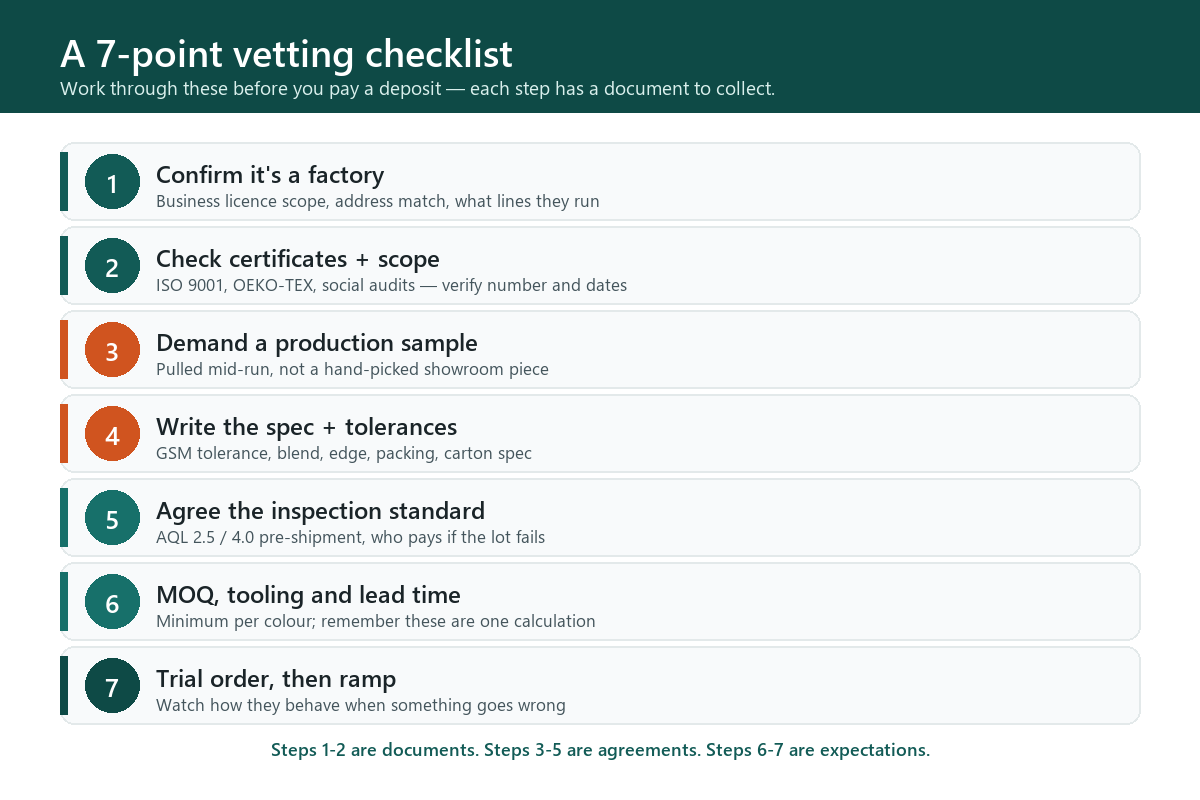
The seven steps below follow the order we’d actually run them in. Steps one and two are document checks you can finish today; steps three to five are agreements you negotiate before money moves; six and seven are about how the relationship behaves once production starts.
Step 1 — Are you talking to a factory or a trading company?
Roughly half the “manufacturers” you meet online are trading companies. That isn’t automatically bad. Good traders consolidate several factories into one container and save you freight, coordination and grey hair. But you need to know who holds your tooling, who controls your fabric, and who pays when something goes wrong.
Three checks settle it in about ten minutes:
- Read the business licence. Ask for the Chinese business licence and look at the 经营范围 line — the registered business scope. A manufacturer’s says 生产 / 制造 (produce / manufacture) followed by the product category. A trader’s says 批发 / 销售 (wholesale / sale). A refusal to send it is itself an answer.
- Match the addresses. The licence address should match the factory address. Drop it into a map and check it looks like a factory, then ask for a live walk-through from the gate to the floor.
- Ask what they actually run. Only a manufacturer knows line lengths, monthly capacity per line, or how much fabric is held in stock. Listen for detail, not enthusiasm.
Rule of thumb: if a supplier quotes within ten minutes of your first message but needs two days to produce a single document, you’re talking to a sales desk, not a factory.
Step 2 — Which certificates actually matter?
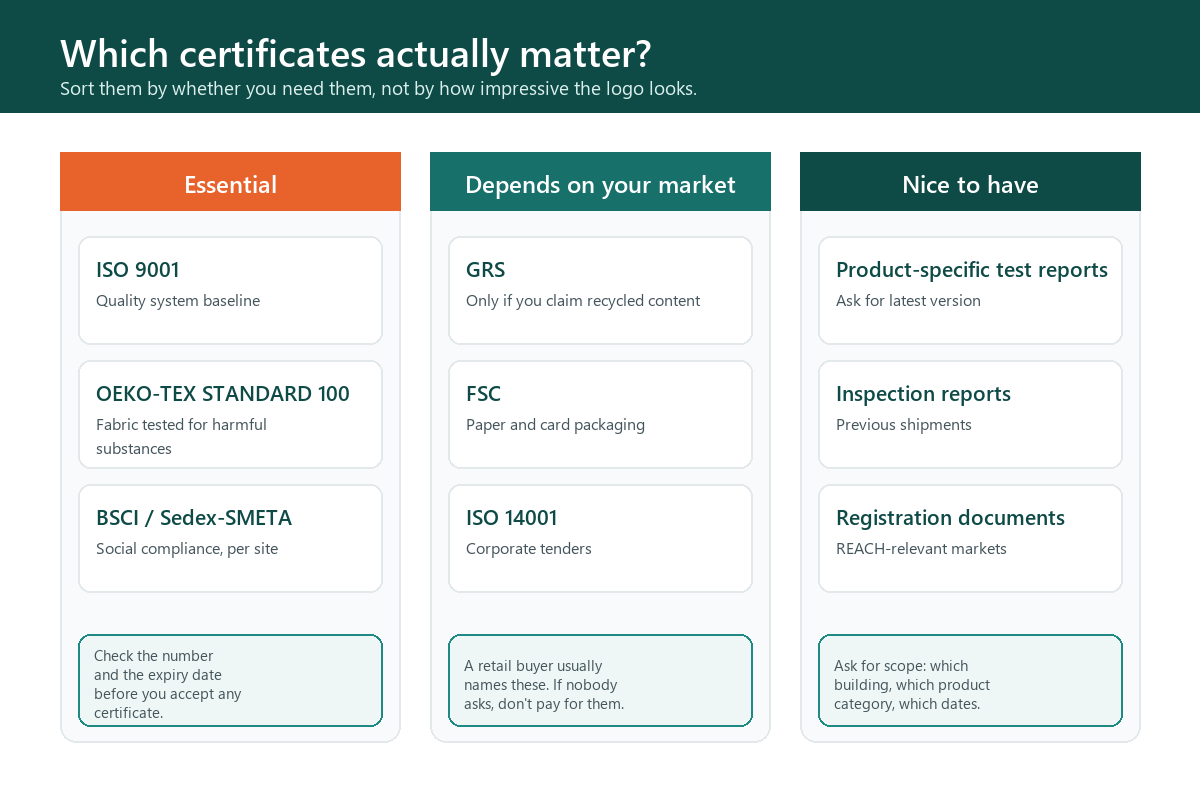
Certificates are where buyers waste the most money. Some are legally required for your market, some are pure marketing, and a surprising number are a PDF someone generated last week with no issue number behind it.
Always ask for two things: the certificate itself, and its scope. A social audit covering one building doesn’t cover the second plant your goods may come from, and a certificate that expired eight months ago still looks fine in a sales deck.
| Certificate | What it covers | When you need it |
|---|---|---|
| ISO 9001 | Quality management system | The baseline for any repeat OEM order |
| OEKO-TEX® STANDARD 100 | Finished fabric tested for harmful substances | EU retail; anything touching skin |
| BSCI / Sedex-SMETA | Social compliance audit at a named site | Required by most EU and UK retail chains |
| GRS | Recycled content traceability | Only if you intend to claim recycled PET |
| FSC | Chain of custody for paper and card | Retail packaging requirements |
| ISO 14001 | Environmental management | Corporate tenders and procurement scorecards |
Two habits worth building. Verify the number — OEKO-TEX, ISO and Sedex all offer public validity checks, and it takes a minute. Check the dates — most certificates run for twelve months and lapse quietly.
Kocean runs ISO 9001 and OEKO-TEX® on its own lines, and we’ll send current copies with scope and validity dates on request. That should be your standard request everywhere, including with us. (If you want the detail behind that label, what OEKO-TEX® actually tests is explained separately.)
Step 3 — Ask for a production sample, not a showroom sample
Here’s the single habit that separates lucky buyers from unlucky ones: don’t evaluate the sample the factory chose.
A sales sample is hand-picked, pressed, and photographed under good light. A production sample is pulled off the line mid-run, during a shift nobody was watching. Ask for both and put them side by side. Check:
- Weight on a scale, not estimated by feel
- Colour under daylight, never under office fluorescent tubes
- Edge finishing — overlock, ultrasonic cut or hemmed edge is exactly where quiet cost-cutting hides
- Lint behaviour after five wet wipes on glass
- The carton you’ll actually receive, including its specification and drop test if the goods ship far
Expect to pay for samples and courier. A supplier who waves both isn’t doing you a favour — they’re just pricing the relationship differently later on.
Step 4 — Put the spec in writing, down to the tolerance
This is the one we’d push hardest on. “Microfiber cloth, 40×40 cm, 300 gsm” is not a spec. Missing from it: the fibre blend (80/20 polyester-polyamide is the standard for cleaning-grade microfiber), whether edges are finished, the tolerance on GSM, absorbency targets, colour fastness grade, and how many pieces go in a carton.
Below is a version a factory can quote without guessing. Copy it, fill in your targets:
Product:             microfiber cleaning cloth
Size:                [__] × [__] cm        (tolerance ±[__] mm)
Weight:              [__] gsm              (tolerance ±[__] %)
Blend:               80% polyester / 20% polyamide
Weave:               [waffle / terry / suede / flat]
Edge:                [overlock / ultrasonic / hemmed] + thread colour
Colour:              Pantone [__] / white
Label:               [woven label / care label / none]
Performance target:  absorbency ≥ [__] g water per g fabric
                     colour fastness to washing ≥ grade [__]
Packing:             [__] pcs per polybag, [__] bags per carton
                     carton [__] × [__] × [__] cm
Quantity:            [__] pcs per colour per production run
Incoterm / port:     [FOB Shanghai / FOB Ningbo]
Those tolerance lines aren’t pedantry. They’re what prevents an argument six weeks later, when the cloth arrives at 265 gsm and both sides remember a different number.
Choosing the fabric itself rather than the finished item? Our comparison of spunlace, spunbond, meltblown and needle-punched nonwovens covers which structure belongs in which cleaning product, with real GSM ranges.
Step 5 — Agree the inspection standard before you pay anything
Most disputes aren’t caused by bad factories. They’re caused by two parties quietly holding different definitions of the word “acceptable.”
There’s an off-the-shelf answer, and it costs nothing: ISO 2859-1, better known in the trade as AQL. You agree an acceptable quality limit up front — 2.5 for major defects and 4.0 for minor is the common default for consumer cleaning goods — along with who pays if a lot fails.
Then write down three more things: who inspects (your own QC team, a third party such as SGS, Bureau Veritas, Intertek or TÜV Rheinland, or the factory’s own inspectors), when they inspect (usually pre-shipment, at 80–100% packed), and what triggers rework or a re-inspection.
Ninety seconds of agreement here saves weeks of correspondence later.
Step 6 — Treat MOQ, tooling and lead time as one question
Buyers nearly always ask these three separately. On the factory’s side they’re one calculation.
MOQ on cleaning textiles almost always means per colour and per size, not per order. A stock-fabric microfiber run often starts around 1,000–3,000 pieces per colour. Custom-dyed fabric is higher, because dyeing has a minimum batch below which the colour can’t reliably be repeated. New woven labels, printed films or moulded parts carry one-off tooling charges worth asking about explicitly, since they’re often quoted as “free” and then recovered somewhere else.
Lead time typically breaks down roughly like this:
| Stage | Typical duration |
|---|---|
| Standard samples | 7–15 days, plus courier transit |
| Custom dye lab dips | 10–20 days |
| First production after approval | 25–45 days depending on the season |
| Repeat orders | Shorter — fabric, trims and artwork are already on file |
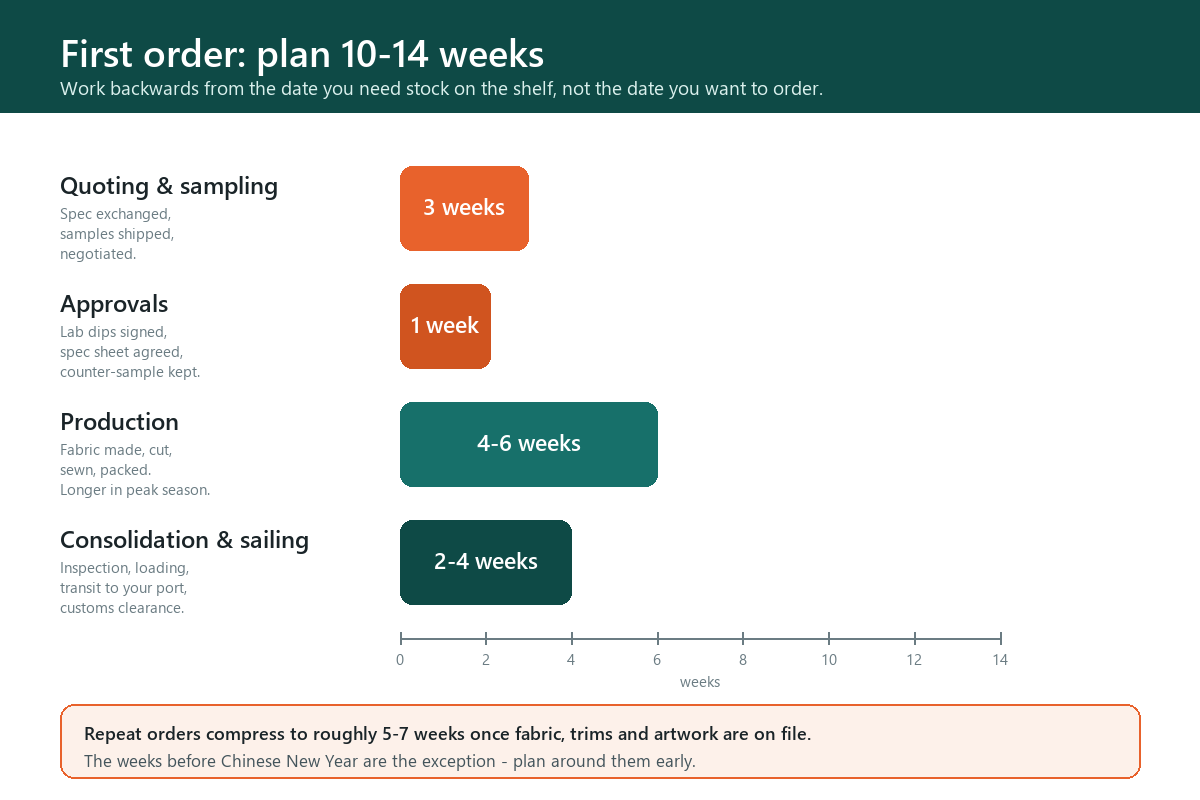
Then add peak season. The weeks running up to Chinese New Year compress everything, and a quantity confirmed in early December behaves very differently from one confirmed in March. Build your calendar backwards from the date you need stock on the shelf, not from the date you want to order.
Step 7 — Run a trial order, then ramp
Almost everybody skips this step.
A trial order — a few hundred to a couple of thousand pieces — isn’t about the money. It’s the only honest test of how a factory behaves when something goes slightly wrong, and something always goes slightly wrong. Watch three things: whether they report a delay before you discover it, whether the second shipment matches the first, and whether the packing list matches the cartons physically standing in front of them.
Then ramp deliberately: one container, then three, then monthly volume. Factories allocate capacity to their repeat buyers when capacity gets tight — which is precisely when you want to be on that list.
Six signals worth reading carefully
| Warning sign | Reassuring sign |
|---|---|
| Price drops 20% the moment you hesitate, with no change to the spec | Explains what actually drives cost: GSM, blend, finishing, packing |
| Refuses or discourages third-party inspection | Volunteers previous inspection reports unprompted |
| Certificate won’t open, or has no number to verify | Sends certificates with issue dates, scope and expiry |
| Every question answered “yes” instantly | Some requests come back as a technical counter-question |
| Can’t name the fabric source or the machine behind your product | Talks about line speeds, jet pressure, dye lots and re-run risks |
| Will quote a tenth of your volume at full-service pricing | Tells you honestly when your volume is below their economic minimum |
A short RFQ email that gets a real quote
Terse enquiries get terse quotes. This one doesn’t, because it’s specific — and the first question filters out half the inbox before you’ve spent any time at all.
Subject: RFQ — [microfiber cloth / mop refill / sponge] — [quantity]

Hello [name],

We are sourcing [product] for [market / sales channel] and would like a quotation.

SPECIFICATION
- Size / weight: [...]
- Material:       [...]
- Colour:         Pantone [...] / white
- Packing:        [...]
- Quantity:       [...] pcs first order, estimated [...] per month thereafter

PLEASE CONFIRM
1. Whether you manufacture this in-house or buy it in
2. Minimum order quantity per colour
3. Certificates you hold, with validity dates
4. Sample cost and sample lead time
5. Standard production lead time after sample approval

We inspect to AQL 2.5 / 4.0 pre-shipment. Please confirm this is acceptable.

Best regards,
[name, company, country]
FAQ
Q: How long between first contact and goods on the water? A: Budget 10–14 weeks for a first development. Roughly three weeks for quoting and sampling, one for approvals, four to six for production, then consolidation and sailing. Repeat orders compress to about five to seven weeks.
Q: Is it cheaper to buy through a trading company? A: Sometimes genuinely yes, often no. A good trader consolidates several factories into one container and saves you freight plus a lot of chasing. A poor one adds margin while removing your ability to fix a problem at its source. Ask who owns the production — that answer matters more than the price difference.
Q: What’s a normal deposit? A: 30% deposit with 70% against a copy of the bill of lading is the standard arrangement for new relationships in this sector. Letters of credit are common with larger, established buyers. Be cautious about requests for 100% prepayment before there’s any shipment history between you.
Q: Can I visit the factory? A: Please do — and an unannounced visit is far more informative than a scheduled one. Short of flying, ask for a live video walk-through during an actual production run rather than accepting a pre-recorded tour.
Q: Do I really need OEKO-TEX® for a cleaning cloth? A: For EU and UK retail, practically yes — retailers ask for it and it also supports your own REACH position. For industrial and janitorial channels it depends on what your customer requires. Either way it’s inexpensive relative to recall risk, and we explain how the standard works elsewhere in the Knowledge Hub.
Asking awkward questions early is cheaper
The buyers we’ve worked with longest all started the same way: a blunt spec sheet, documents requested twice, and a demand for a random sample off a running line. Every one of those requests is reasonable, and a good supplier is relieved rather than offended by them.
If you’d rather skip the vetting paperwork for now, start from the product range and send whatever spec you have — incomplete is fine. We’ll come back with an honest quote and tell you straight what’s missing.